A Journey Toward Relational Consciousness
Introduction
We are living in a time where the complexity of the world has grown faster than our own capacity to understand it. Social networks, artificial intelligence, globalization, data, and the speed of change surround us, yet our internal complexity, our ability to notice, interpret, and relate with awareness, remains limited. Each day, it feels more urgent to be able to “see” clearly how we are acting, how we are relating, and how our decisions, no matter how small, impact systems much larger than ourselves.
I remember a meeting with a group of community leaders where we were discussing how to improve collaboration across organizations. Each person had brilliant ideas about policies, strategies, and structures, yet no one seemed to notice how the conversations were undermining themselves: judgments, assumptions, automatic interpretations, invisible stories generating subtle tensions. In that moment, I realized something profound: the change we seek outside; in systems, organizations, communities, begins within, in our capacity to look, listen, and respond with presence.
The philosopher Martin Heidegger suggested that human beings do not relate to the world from a neutral position. We are always already “thrown” into a way of interpreting, understanding, and making meaning of what happens. We do not see reality as it is, but through a background of meaning that we rarely question.
This implies something fundamental.
Most of our decisions do not arise from objective observation, but from interpretations we take for granted. We live within invisible frames of meaning.
And when those frames are not made explicit, they end up governing our actions without us realizing it.
Working with teams and organizations, I began to see this in real time. Intelligent, committed people, with good intentions… trapped in dynamics they could not fully see. Not because they didn’t want to.But because they couldn’t.
That’s when something began to take shape:
The problem is not only what is happening. It’s how we are seeing it.
We constantly face an invisible obstacle: the automation of our perception. We are so used to responding in certain ways, to interpreting others through our own stories, that we don’t even notice we are repeating patterns that limit our capacity for connection and effective action. These patterns don’t just affect our immediate relationships, they scale into broader systems, shaping the culture of organizations, communities, and entire societies.
That is why, before talking about structures, policies, or external tools, we need to train our inner gaze. We need to recognize the levels of responsibility and the circles of belonging that surround us—from our ego to the bioregion, culture, and humanity. We need to ask: To what extent is the way I act and relate contributing to the problems I want to solve? How can I expand my perception to include not only those around me, but also future generations and the planet we inhabit?
This is not a simple task. It involves facing discomfort, uncertainty, and sometimes a crisis of meaning. But it is also deeply liberating. Because when we learn to “see” together; when we create spaces to share stories, interpretations, and perspectives, we discover that solutions are not individual or external: they emerge from the group, from conscious dialogue, and from collective practice. That is where new ways of relating and acting are born.
From developmental psychology, Robert Kegan showed how our capacity to construct meaning evolves in stages, and how many modern tensions arise when the world demands levels of complexity that our internal structure cannot yet hold.
Similarly, Jane Loevinger explored ego development as a progressive expansion of our ability to integrate perspectives, showing that not all of us interpret reality from the same level of complexity.
From another angle, the philosopher Maurice Merleau-Ponty argued something similar: perception is not a passive mirror of reality, but an active way of being in the world. To perceive is already to interpret—it is already to participate. We are not observing the world from the outside. We are in it. We co-create it in every interaction.
This idea becomes even clearer when we enter the social realm.
Peter L. Berger and Thomas Luckmann proposed that social reality is not fixed, but something we collectively construct through language, conversations, and shared practices.
What we consider “normal.”What we take as “true.”What we see as “possible.”
All of this emerges in relation.
Biologists Humberto Maturana and Francisco Varela expressed it clearly: there is no knowledge outside of relationship. What we call reality emerges in the coupling between the observer and their environment. There is no observation without participation. There is no system without observers who constitute it.
And this leads us to an uncomfortable, but necessary conclusion:
We are not separate from the systems we want to change. We are active participants in them.
So any attempt at transformation that ignores this reality is incomplete.
This article, then, is a journey. A journey that begins with individual perception—exploring how our ways of seeing and deciding shape our environment—and expands toward the creation of conscious communities capable of transforming entire systems. It does not aim to offer definitive solutions or magic formulas, but rather to illuminate a possible path: to show that relational practice is a muscle we can all develop, and that doing so has real and profound consequences in our families, teams, communities, and in the world we share.

Individual Consciousness and Levels of Presence and Responsibility
Before looking outward, we need to look inward. The way we interpret the world, how we relate, and how we act all arise from our capacity to notice what is happening, from our mental structures, and from our sense of responsibility toward those and that which surround us.
If we accept that we do not see reality directly, but rather through filters—such as inherited beliefs, expectations about the future, past experiences, unresolved trauma, cultural conditioning, and structures of meaning—then a set of questions becomes inevitable:
What defines these structures?Why do we see what we see?And perhaps more importantly, why don’t we see what we don’t see?
This is where it becomes useful to distinguish three dimensions that operate simultaneously in every experience:
Awareness (the act of noticing)This is the ability to recognize what is happening in the present moment: thoughts, emotions, judgments, and the invisible stories unfolding within us. It is the capacity to notice when our mind is caught in its own narrative and when we are responding automatically.
Consciousness (the capacity for meaning-making)This includes not only what is in front of us, but also the mental structures that allow us to interpret it. It is our ability to hold multiple perspectives, question assumptions, and recognize the invisible patterns that guide our decisions.
Conscience (moral awareness or responsibility)This refers to the domain toward which we feel responsible. It defines what we consider important, worthy of care, or deserving of action. It is not enough to notice and understand; we must also ask: toward whom or what do we feel accountable? This dimension connects observation and interpretation with conscious and ethical action.
These three dimensions are not independent. They are constantly intertwined. What I am able to notice depends on my structure of consciousness. And what I do with that depends on my sense of responsibility.
Ken Wilber, in his integral model, suggests that human development involves multiple dimensions, cognitive, emotional, moral, cultural, and systemic, and that we cannot reduce human complexity to a single line of growth. This is important because we often try to solve complex problems with a single form of intelligence.
More data. More analysis. More logic.
In this context, the levels of presence and responsibility we are exploring become a practical tool for training consciousness.
This map also resonates with decades of research in human development. From developmental psychology, Robert Kegan and Lawrence Kohlberg showed that we do not simply accumulate knowledge over time—we transform the way we construct meaning and understand responsibility. As we grow in mental and moral complexity, we expand our capacity to hold multiple perspectives, question our own assumptions, and act with awareness of broader systems. What is being proposed here is not a parallel model, but a practical way of grounding those levels in everyday conversational experience.

Each level represents a different space where perception and action unfold:
Story (what I believe happened)
At this level, we identify our narratives and automatic versions of reality. The challenge is to notice when we are trapped in our personal stories and how these shape our perception of others.
Interpretation (what it means to me)
This is where judgments and assumptions arise. Consciousness here involves recognizing that our interpretations are not facts, but lenses through which we filter reality.
Relationship (how I see the other)
We project emotions, expectations, and fears onto others. The work is to differentiate what belongs to our internal story from what is actually happening with the other person.
System (patterns I am part of)
At this level, we begin to see recurring dynamics and invisible structures that shape our interactions. Noticing these patterns allows us to intervene more effectively.
Agency (how I participate and act)
We recognize that we always have choices, and that our actions matter. Consciousness here translates into deliberate choice and active responsibility.
Identity / Meaning (who I am and where I interpret from)
This level invites reflection on deeper beliefs, internalized culture, and the ways in which our identity shapes our decisions. It is where self-observation meets authenticity and intention.
In practice, these levels do not operate sequentially or in isolation—they are active simultaneously and influence each other. For example, while facilitating a community of practice, one participant realized that their resistance to a proposal was not about the idea itself, but about a pattern of control inherited from a previous organizational experience (System level), and how that resistance was connected to a need to be seen and recognized (Identity / Meaning level). Noticing this opened space for authentic dialogue and more conscious action.
The goal of integrating Awareness, Consciousness, and Conscience with these levels of responsibility is twofold: first, to expand our capacity for observation and reflection; and second, to translate that observation into meaningful action that impacts our circles of belonging—from the self to the bioregion, including family, peers, community, culture, and humanity.
Each conscious interaction strengthens relational practice and prepares us to participate more effectively in communities of practice, where transformation is collective and sustained over time.
Ultimately, training these levels of consciousness is not just an intellectual exercise—it is an act of commitment and responsibility toward ourselves and the systems we are part of. Every conversation we engage in, every decision we make, is an opportunity to practice presence, listening, and responsibility. As we cultivate these relational muscles, we not only grow individually, but also expand the capacity of our teams, communities, and, eventually, our society to respond to the complexity of our time with clarity, care, and consciousness.

Circles of Belonging
If the previous section invited us to look inward, this one invites us to expand our gaze outward. Not as a sudden leap, but as a natural expansion. Because in reality, we are never isolated. We are always in relationship. We are always belonging.
The question is not whether we belong, but what we belong to… and how conscious we are of it.
Throughout our lives, we move within different circles of belonging that shape our identity, our decisions, and the way we act in the world. These circles are not static, nor are they hierarchical in a traditional sense; they are layers of relationship that expand as our capacity for consciousness and responsibility grows.
We can begin with the closest one.
The first circle is the ego or self. This is the space where we live our internal experiences—our emotions, thoughts, stories, and needs. It is where we interpret reality and where our identity is constructed. For a long time, this circle dominates our perception. We see the world through what affects us, what we need, what we believe we are. There is nothing “wrong” with this; it is the starting point. But when we remain only here, our capacity to understand and influence broader systems becomes limited.
The second circle is the immediate family. This is where we learn our first ways of relating, communicating, and interpreting the world. Many of our deepest beliefs are formed here. The way we handle conflict, express emotions, or understand care and responsibility often has its roots in this circle.
The third circle is that of peers, friends, colleagues, people with whom we share everyday spaces. Here, we begin to contrast our stories with those of others. New perspectives emerge, along with new tensions and new possibilities for learning. This is a key space, because many of our daily decisions are shaped by how we want to be perceived within this group.
The fourth circle is the extended family or chosen family (partners, close networks beyond the immediate). This level adds complexity to our relational dynamics. Here, we do not only respond from inherited habits, but in some cases begin to question them.
The fifth circle is the community, the neighborhood, the organization, the local network. At this level, something new appears: a sense of the collective. Decisions no longer affect only those close to us, but broader systems. And yet, we often participate at this level without full awareness, reproducing patterns without noticing how we contribute to them.
The sixth circle is nature or the bioregion. This is an important turning point. Here, we stop seeing ourselves only in relation to other humans and begin to recognize ourselves as part of a larger living system. The water we use, the air we breathe, the food we consume, the territories we inhabit—everything is interconnected. And yet, in many of our daily decisions, this level remains invisible. We act as if we were separate from nature, when in reality we are an expression of it.
As our consciousness expands, even broader and more complex circles emerge.
The seventh circle is culture, the values, norms, and collective narratives that shape how we understand the world. Many of our most deeply rooted beliefs are not individual, but cultural. They are so normalized that we rarely question them. And yet, these structures shape our institutions, our policies, and our ways of relating.
The eighth circle is humanity as a whole. Here, the question shifts. It is no longer only about how my decisions affect my immediate environment, but how they contribute to the well-being—or deterioration—of humanity as a whole. This level requires greater abstraction, but also a deeper sensitivity to global interdependence.
And finally, the ninth circle is the planet as a whole and future generations. This level invites us to move beyond the immediate present and consider the impact of our actions beyond our own lifetime. It confronts us with questions that are not always comfortable: What kind of world are we building? What consequences will our decisions have in one hundred or two hundred years? What responsibility do we have toward those who do not yet exist?

As we move through these circles, something becomes evident: each expansion requires a greater capacity for consciousness. We cannot sustain responsibility for broader systems if we have not developed the internal capacity to perceive, understand, and act in relation to them.
And here, an important tension appears.
Because even though all these circles are always present, our attention and our sense of responsibility are not always evenly distributed. We may have a high level of awareness in our professional circle, for example, but low awareness within our family. Or we may care deeply about global issues, while failing to notice how our daily interactions contradict those values.
This is not about “reaching” a higher level or abandoning the previous ones. It is about integration. About recognizing that all these circles coexist, and that our practice lies in expanding our capacity to hold them simultaneously.
In one of the communities of practice I facilitated, this became very clear. A participant spoke passionately about the environmental impact of certain organizational decisions, while at the same time recognizing that, within their immediate team, they avoided difficult conversations out of fear of conflict. That tension was not a mistake—it was an invitation. An opportunity to align their consciousness across different levels and bring their sense of responsibility into everyday practice.
Because in the end, it is not enough to understand these circles conceptually. What matters is how we live them. How our daily decisions reflect—or fail to reflect—the breadth of our awareness.
And this is where everything begins to connect.
Our ability to move between these circles, to recognize where we are operating at any given moment, and to expand our sense of responsibility, does not happen in isolation. It is not something we simply decide and then achieve. It is a practice. A practice that is strengthened in relationship with others.
And this is where, naturally, something else begins to emerge.
The need for spaces where we can see ourselves, question ourselves, and learn together. Spaces where we can practice this expansion of consciousness collectively. Spaces where we do not only understand these circles, but actually live them.
And that, slowly, leads us toward the next step in this journey.
The Three Fundamental Movements (Seeing, Disorganizing, Reconfiguring)
At the heart of communities of practice, three fundamental movements make transformation possible: seeing, disorganizing, and reconfiguring.
Seeing means making visible what normally remains hidden: our stories, interpretations, identities, and relational patterns. It is the first step toward developing shared consciousness. What was previously implicit begins to surface. What operated automatically becomes observable.
Disorganizing involves opening cracks in our certainties. It introduces discomfort, questions what we take for granted, and loosens our habitual ways of thinking and acting. It is not about destroying meaning, but about creating enough space for it to evolve. Without this movement, we tend to reinforce the same patterns, even when we intend to change them.
Reconfiguring is the moment when something new begins to emerge—not as a predefined solution, but as a more conscious way of relating and acting together. It is where new possibilities take shape through interaction, rather than being imposed from the outside.
These movements are not linear or isolated; they are constantly intertwined. We see something, it destabilizes our current understanding, and from that tension, new ways of acting begin to form. And then the cycle repeats.
It is precisely within this dynamic that groups move from automatic reaction to more conscious, relational, and adaptive responses.

Where Consciousness Becomes Practice (Toward Communities of Practice)
If something becomes evident as we move through the circles of belonging, it is that consciousness is not a destination we reach, but a capacity we need to practice. It is not enough to understand these levels conceptually. It is not enough to recognize that we are part of broader systems. The real question is more uncomfortable, and more practical:
How do we train our capacity to see, hold, and act from that complexity in everyday life?
Because in real life, things do not happen in theory.
They happen in conversations.
They happen in small decisions.
They happen in moments when we are tired, reactive, or under pressure.
And it is precisely there that we return, again and again, to our automatic patterns.
We may fully understand the importance of the bioregion, the community, or even future generations—but in a difficult conversation with a colleague, we fall back into the level of story or interpretation without noticing it. We may speak about complex systems, yet in practice we continue reacting from the ego.
Not because we do not want to do better, but because we have not sufficiently trained our capacity to do things differently. This is where many change initiatives begin to fail.
We try to transform systems through correct ideas, but without developing the internal and relational capacities needed to sustain those ideas in practice. We design strategies, structures, and processes, but leave untouched the way people perceive, interpret, and relate within those systems.
And then something predictable happens: the system does not change—or it changes superficially, only to return to its original patterns.
Over time, I have come to see that the problem is not the lack of good ideas. It is the lack of spaces where we can practice how to live those ideas together.
I remember an organization that had a very clear vision around collaboration, social impact, and sustainability. On paper, everything was aligned. But in meetings, the dynamics were different: constant interruptions, little real listening, decisions made from urgency rather than reflection. There was no bad intention, but there was a gap between what was said and what was practiced. When we opened a weekly space to observe not only what decisions were being made, but how they were being made, something began to shift. Not immediately, not perfectly, but genuinely. People began to notice their own patterns, to name them, to question them, and gradually, to act differently.
This is where Otto Scharmer’s work offers a key distinction. Scharmer speaks of the “blind spot” in leadership: that place from which we operate, but which we do not see.
It is not what we do. It is not what we say.
It is where we do it from, and how consistently we practice it with others.
That “from where,” and that consistency of practice, define the impact of our actions.
Two leaders can implement the same strategy and generate completely different outcomes, depending on the quality of their attention, their presence, and their ability to perceive the system they are part of.
Because attention, consciousness, and conscience, when not practiced, fade. They become intention, discourse, something we know but do not embody. But when practiced in relationship with others, they begin to take form. They become visible, tangible, shared.
We begin to see things we could not see alone.We begin to hold conversations we would otherwise avoid.We begin to act in ways we would not have considered on our own.
Relational practice has something unique: it cannot be developed in isolation.
It requires others.
It requires interaction, friction, difference.
It requires spaces where we can experiment with new ways of listening, interpreting, and acting.
And yet, most of our environments are not designed for this.
In many spaces, what is rewarded is efficiency, speed, certainty. There is little room for pause, for questioning, or for collectively exploring what is happening beneath the surface. And without those spaces, relational practice simply does not happen.
That is why, when we speak about expanding consciousness through circles of belonging, we inevitably arrive at a conclusion: we need to create environments where that expansion is possible.
Environments where we can practice.
Environments where making mistakes is not failure, but part of the learning process.
Environments where intimacy, trust, and vulnerability can emerge without fear of judgment.
Environments where we can see ourselves not only as individuals, but as active participants in the systems we inhabit.
Over time, these environments have been called by different names. But there is one that captures very clearly what happens within them:
Communities of practice.
Not as an abstract concept, but as something deeply human.
People who share an interest, a concern, or a purpose, and who choose to come together continuously, not only to solve problems, but to learn how to relate, perceive, and act more consciously.
In essence, they are spaces where consciousness stops being individual and becomes collective.
Where circles of belonging become visible in practice.Where levels of presence and responsibility can be observed in real time.
And perhaps most importantly: where we stop carrying the burden of “being more conscious” alone, and begin to sustain that process together.
Because something becomes clear when we walk this path long enough:
Deep transformation does not happen in isolation.
It happens in relationship.
And if that is true, then the question is no longer only how we develop individual consciousness, but how we create the conditions for that consciousness to emerge, be sustained, and evolve collectively.
That is where this journey begins to take a new direction.
Not only inward.Not only outward.But toward the space between us.

Communities of Practice (Where Learning Is Relating)
If we have made it this far, something begins to become evident:
Consciousness does not grow in isolation.
It reveals itself, is challenged, and expands in relationship.
So we need spaces where that expansion does not depend on chance, but is intentional. Spaces where we can practice how to see, how to listen, how to interpret, and how to act more consciously, again and again.
That, in essence, is what we call communities of practice.
The concept is not new. It was developed by Etienne Wenger together with Jean Lave, after observing something simple yet deeply revealing: people do not primarily learn through formal instruction, but through participation in shared practices with others.
We learn by doing, but above all, we learn by doing with others. Again and again.
A community of practice is, in its simplest form, a group of people who share an interest, a concern, or a way of doing something, and who meet regularly to learn how to do it better through interaction. It is not only about exchanging information, but about developing a living practice.
Three elements sustain it:
First, a shared domain.Something that matters. It could be improving collaboration within a team, regenerating a territory, transforming organizational culture, or learning to hold more conscious conversations. Without a domain, there is no direction.
Second, a community.People who relate, who build trust, who get to know each other beyond functional roles. Without community, there is no depth.
Third, a shared practice.Not just ideas, but concrete ways of doing—how we converse, decide, intervene. Without practice, everything remains at the level of intention.
When these three elements align, something powerful happens:
Learning stops being individual and becomes collective.
Consciousness stops being abstract and becomes observable.
Change stops being sporadic and becomes sustained.
I remember a community of practice we facilitated with a group of leaders from different organizations. At the beginning, everyone came with the impulse to share solutions, frameworks, methodologies. It was natural, that is what we have learned to do.
But gradually, something began to shift.
Instead of focusing only on what to do, we began to observe how we were being while trying to do it.
What stories were we bringing?
What unquestioned interpretations were guiding our decisions?
How were we actually listening to one another?
The conversations became slower—but also deeper.
There were uncomfortable moments. Long silences. Questions without immediate answers. But something else began to emerge: shared clarity. Not because everyone thought the same, but because they began to see together.
That is one of the clearest indicators of a mature community of practice: it is not the absence of conflict, but the capacity to hold it with consciousness.
In many contexts, there is an idea that communities of practice should be completely informal, self-organized, almost spontaneous, as if structuring or facilitating them would go against their nature.
But in practice, this is not always the case.
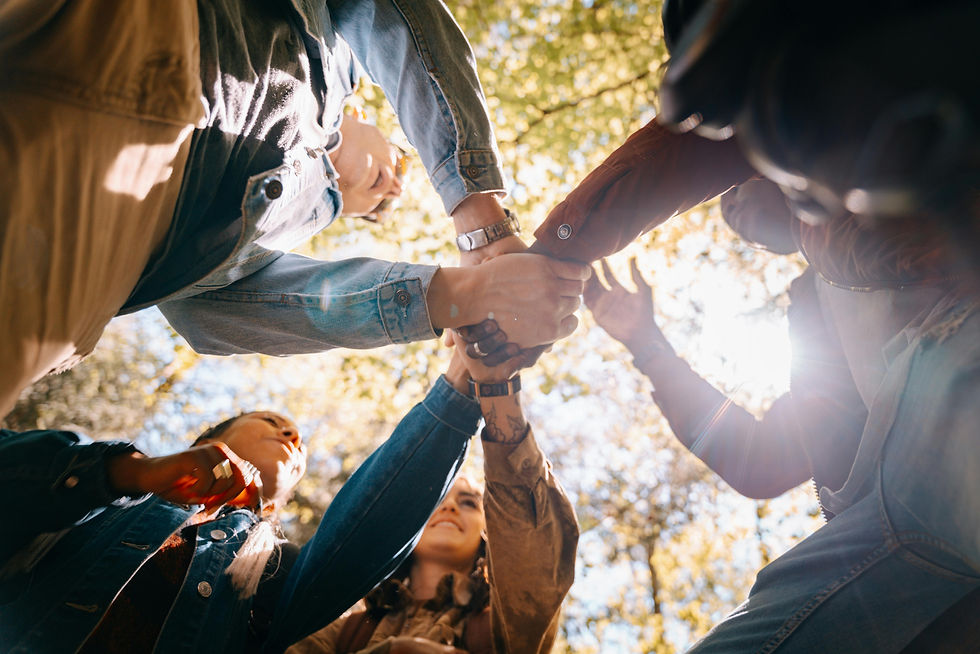
I have seen communities that, without a minimum level of structure or facilitation, quickly dissolve. Conversations become superficial, commitment fades, and the practice disappears. Not because of lack of interest, but because of lack of containment.
Facilitating a community of practice does not mean controlling it. It means holding a space where consciousness can emerge. It means caring for the rhythm, the quality of conversations, the depth of the questions.
It is, in itself, a relational act.
And this is where everything we have explored so far becomes tangible.
Levels of responsibility begin to appear in real time.Someone speaks from the level of story.Another reacts from interpretation.Someone else begins to see the system.
And gradually, the group moves toward agency.
Circles of belonging also become visible.
A decision that seemed individual reveals its impact on the team.A tension between colleagues reflects a broader cultural pattern.A local conversation opens questions about the community, or even the bioregion.
What was previously invisible becomes evident.
And what was previously automatic becomes a choice.
In another experience, working with a community in a territorial context, the initial focus was to solve a concrete issue related to the use of local resources. But as the sessions progressed, the group began to notice something deeper: it was not only a technical problem—it was a relational one.
Lack of trust.Accumulated stories between stakeholders.Unspoken interpretations.
When this came to the surface, the conversation shifted completely. The solution did not come from a better tool or more information, but from the group’s increased capacity to see itself as a system.
That is what communities of practice do at their best.
They do not just solve problems.They transform the way people participate in the systems where those problems exist.
And that has profound implications.
Because if we want to change organizations, communities, or even broader systems, it is not enough to intervene at the surface. We need spaces where people can practice new ways of relating, perceiving, and acting.
Communities of practice are one of the simplest—and at the same time, most powerful—ways to do that.
They do not require sophisticated technology.They do not require large investments.They require intention, continuity, and care.
And above all, they require something we often forget: Time.
Time to observe.
Time to listen.
Time to disorganize what we thought was certain.
Time to build something new together.
In a world obsessed with speed, this may seem counterintuitive.
But perhaps that is precisely the point.
The complexity we face today is not solved faster.
It is solved with greater depth.
And depth can only be developed when we give ourselves the space to practice it.
If we return to the beginning of this journey, we may remember that the challenge of our time is not only external. It is internal and relational. It has to do with our capacity to hold multiple perspectives, to assume responsibility beyond our immediate circle, and to act with consciousness in complex systems.
Communities of practice are not the only answer, but they are a very concrete entry point.
They are the place where all of this stops being theory.
Where consciousness is trained.
Where relationship becomes the vehicle for learning.
And where, little by little, we begin to build something that cannot be imposed from the outside:
A new way of being together.

Implications for Organizations and Society (Beyond Information, Toward Relationship)
If something becomes clear throughout this journey, it is that the challenge we face is not only technical, nor even purely strategic. It is deeply human.
For a long time, we have operated under an implicit assumption: that if we have more information, better tools, and more efficient systems, we will make better decisions and solve more complex problems.
But reality is showing us something different.
We have never had so much access to information, and yet we continue to face conflict, polarization, short-term decision-making, and systems that fail to sustain collective well-being. This is not due to a lack of data. It is due to the way we interpret that data, the way we relate to one another, and the level of consciousness from which we act.
In other words, the limit is not out there. It is within us, in our capacity to process, relate, and respond to complexity.
This has direct implications for organizations.
Many organizations today invest in technology, processes, agile methodologies, and more flexible structures. All of this is valuable. But there is something that is rarely addressed with the same level of depth: the quality of the conversations that sustain those structures.
How are decisions actually made?
What stories are not being told?
What interpretations are guiding actions without being questioned?
What relational patterns are being repeated over and over again?
I have worked with highly capable teams, with access to top-level information, who nonetheless became trapped in relational dynamics that completely limited their ability to act.
Constant interruptions.
Lack of real listening.
Decisions driven by urgency or defensiveness.
Avoidance of difficult conversations.
None of this appears in indicators, KPIs, or OKRs.
And yet, all of it defines outcomes.
When we begin to introduce spaces for relational practice, something shifts. Not because people did not know what needed to be done, but because they begin to see how they are participating in what is happening.
I remember an organization where, after several sessions, a manager said something that captured the shift perfectly:“It’s not that we didn’t know what to do. It’s that we weren’t seeing how we were blocking each other.”
That kind of clarity does not come from more information. It comes from more consciousness in relationship.
And this is not only an organizational issue.
It is social.
People speak, but do not necessarily listen.They debate, but do not necessarily understand.They react, but rarely reflect together.
We are living in a moment where fragmentation and polarization are increasingly evident. At the community, cultural, and global levels, we see how differences are amplified and how our capacity to hold complex conversations is diminishing.
This is where a deeper reading of the moment becomes necessary. As Vanessa Machado de Oliveira suggests, many of the challenges we face today are not simply the result of lacking information or better tools, but of something more difficult to address: deeply ingrained patterns of denial. We deny our participation in the systems we criticize. We avoid recognizing the unsustainability of many of our ways of life. And perhaps most importantly, we disconnect from our interdependence with others and with the environment.
This changes the nature of the problem.
Because it is no longer only about learning something new, it is about being willing to see what we have avoided seeing. And that is not purely a cognitive process. It is relational, emotional, and deeply human.
In this context, it is not surprising that many of the solutions we attempt to implement fail to generate the expected impact. We are trying to solve systemic problems without developing the relational capacities needed to address them.

And here, a key idea emerges:
If the problem is relational, then the infrastructure must also be relational.
It is not enough to design better policies or systems if we do not also design spaces where people can learn to relate more consciously within those systems.
This implies a shift in focus.
From seeing learning as something individual, to understanding it as something collective.From focusing only on results, to paying attention to the processes that generate them.From optimizing efficiency, to cultivating the quality of relationships.
This shift also invites us to question something deeper: what we understand as learning. As Vanessa Machado de Oliveira points out, much of our educational systems have been oriented toward solving ignorance (transmitting information, developing skills), but not necessarily toward addressing denial (what we avoid seeing, feeling, or acknowledging). And many of today’s challenges are not about lack of knowledge, but about our difficulty in confronting discomfort, our participation in the problems, the complexity of situations, and the absence of simple answers.
This changes the role of learning.
It is no longer only about acquiring new ideas, but about developing the capacity to hold difficult truths without shutting down, without reacting automatically, and without breaking the relationship with others in the process.
Communities of practice become, in this context, a fundamental piece of what we could call relational infrastructure. Not as something optional or “nice to have,” but as an essential component for systems to function in a healthy and adaptive way.
In organizations, this can take many forms:
Regular spaces where teams do not only review results, but how they are working together.
Cross-functional groups that explore shared challenges from different perspectives.Teams that sustain difficult conversations continuously, not only in moments of crisis.
In local communities, it can take the form of gatherings where neighbors do not only discuss problems, but learn to listen, understand differences, and co-create solutions from a foundation of trust.
It is not technically complex.But it is deeply transformative in human terms.
Because what changes is not only what we do. It changes who we are in relation to others. And that has a multiplying effect.
A person who develops greater relational consciousness impacts their team.A team impacts its organization.An organization impacts its community.
And in this way, transformation begins to expand.
But there is something important to acknowledge:
This does not happen automatically.
It requires intention.
It requires attention.
It requires willingness.
It requires practice.
It requires holding spaces over time, even when there are no immediate results.
In a world that rewards speed, this may seem contradictory. But if something has become clear, it is that the problems we face today cannot be solved with quick fixes.
They require depth.
And depth is built in relationship.
If we return to the initial idea of this article, that the complexity of the world has outpaced our internal complexity ,then the question is no longer only how we adapt to that complexity, but how we grow in order to hold it.
And that growth is not only cognitive.
It is relational.
It is attentional.
It is emotional.
It is collective.
It involves learning to disagree without fragmenting.
It involves learning to see systems without losing sight of people.
It involves learning to act with responsibility beyond our immediate self-interest.
Communities of practice offer a concrete path for developing these capacities. Not as a perfect solution, but as a space where the human dimension returns to the center. Where relationship is no longer a means, but the foundation.
And perhaps, in a moment like the one we are living, that is exactly what we need.
Not more speed.
Not more information.
But more capacity to be together, consciously.

Closing (An Invitation to Practice Together)
If we look back, this journey has not been linear. It has been more like an expanding spiral.
We began with a simple yet profound intuition: that the complexity of the world has grown faster than our internal capacity to hold it. And little by little, we explored what that truly means.
We saw that our conversations are not neutral. That they are filled with stories, interpretations, and patterns that we rarely question.
We explored how our capacity to notice (awareness), to understand (consciousness), and to take responsibility (conscience) defines the quality of our decisions and relationships.
We discovered that as our ability to notice, understand, and take responsibility expands, so does our internal complexity. And with it, our ability to hold multiple perspectives, question our assumptions, and reinterpret what is happening. From there, our relationships begin to change, our decisions become more conscious, and meaning itself shifts—from something fixed to something we co-create.
We expanded our view toward circles of belonging, recognizing that we do not act only from the ego, but within increasingly broader systems: family, peers, community, bioregion, culture, humanity, and the planet itself.
We realized that understanding these levels conceptually is not enough. That real transformation happens when we are able to see, disorganize, and reconfigure the ways we show up and act in the world.
And perhaps most importantly, we recognized that this process cannot be sustained alone.
It requires others.
It requires spaces where we can practice.
That is where communities of practice stop being an interesting idea and become essential.
Not as another methodology.
Not as an additional structure.

But as a living space where consciousness is trained, relationships are cared for, and action emerges from a deeper place. But this does not happen just because we understand it.
It happens when we practice it.
In a difficult conversation where we choose to listen instead of react.
In a meeting where we decide to name what usually remains implicit.
In a group that gathers not only to solve problems, but to observe how those problems are being generated.
These are small gestures, but they are not trivial. They are the places where a different way of being together is built.
Sometimes we think that change requires large movements, massive transformations, disruptive innovations. And in many cases, that may be true. But there is a more fundamental level, the level where it is defined how we look at one another, how we listen, and how we make decisions together.
If that level does not change, everything else tends to reproduce itself.
That is why creating communities of practice is not a minor act.
It is a deeply strategic, and deeply human, act.
It is choosing to care about how we learn and how we relate.
It is recognizing that sustainable change is not imposed, it is cultivated.
It is committing to processes that may not deliver immediate results, but that build capacity over time.
It also means acknowledging something uncomfortable.
The educational systems in which we were formed did not necessarily prepare us for this kind of work. As Vanessa Machado de Oliveira points out, we have been trained to prioritize knowledge accumulation, certainty, and correct answers, but not to hold ambiguity, discomfort, or relational complexity. We know how to analyze, but not always how to listen. We know how to argue, but not necessarily how to dialogue.
And that is where many of our attempts at change meet their limit.
The most important thing is that this is not distant or exclusive. We do not need to wait for someone else to do it.
We can start where we are.With the people we already interact with.
In the teams we are part of.
In our communities, neighborhoods, and organizations.
A community of practice can begin with something as simple as a group of people who decide to meet regularly with a different intention.
Not only to move tasks forward, but to observe how they relate.Not only to solve problems, but to understand them together.Not only to express opinions, but to listen.
That is exactly what I am building.
I design and facilitate the conditions where individuals, teams, and organizations can develop these capacities in a sustained way.
Not as theory.Not as momentary inspiration.
As a living practice.
Spaces where something very concrete happens:
We learn to see how we are participating in what is happening.We learn to question it without breaking the relationship in the process.We learn to act more consciously, together.
And when that happens, something shifts.
Not only in conversations.Not only in decisions.
The way the system itself functions begins to change.
If this resonates with you, we can explore it together.
Not from a predefined solution.But from a different kind of conversation.
Because many times, change does not begin with an answer. It begins with a space where we are able to see something new.
We do not need to wait for the world to change in order to begin relating differently.
We can start now.
In the next conversation.
In the next decision.
In the next moment when something meaningful is at stake.
The question is not whether the system will change.
It will.
The question is:
From where will we participate in that change?
This article is not a conclusion.
It is an invitation.
To observe with more attention.
To question with more openness.
To relate with more consciousness.
And above all, to practice.
To practice together.
Because if something has become clear throughout this journey, it is that the quality of the future we are building depends, to a great extent, on the quality of the relationships we are able to sustain today.
And that… that is in our hands.


Comments